COATING: |
CHROME 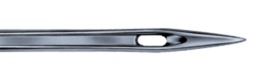 Needles with a normal chrome coating can be recognized by their shiny silver surface. The chrome coating provides protection against wear and corrosion. The surface is smooth and protects the material and the thread. Chrome needles can be used for all standard applications. Compared to nickel-plated needles, chrome-plated needles improve the service life of the needle at higher stitch counts. At Groz-Beckert, the equivalent chrome coating is being gradually replaced by their more environmentally friendly "dur" process. Needles with a normal chrome coating can be recognized by their shiny silver surface. The chrome coating provides protection against wear and corrosion. The surface is smooth and protects the material and the thread. Chrome needles can be used for all standard applications. Compared to nickel-plated needles, chrome-plated needles improve the service life of the needle at higher stitch counts. At Groz-Beckert, the equivalent chrome coating is being gradually replaced by their more environmentally friendly "dur" process.
|
MATERIAL TYPE: |
TISSUE
Tissue is a textile fabric consisting of at least two thread systems, warp and weft, which cross each other at an angle of exactly or approximately 90° when viewed on the fabric surface.
Each of the two systems can be made up of several types of warp or weft (e.g. basic, pile and filling warp / basic, binding and filling weft). The warp threads run in the longitudinal direction of the fabric, parallel to the edge of the fabric, and the weft threads run in the transverse direction, parallel to the edge of the fabric.
The threads are mainly connected to the fabric by friction. In order for a fabric to be sufficiently non-slip, the warp and weft threads usually have to be woven relatively densely. That is why, with a few exceptions, the fabrics have a coherent appearance.
To sew fabric, positive displacement needles are always used and never a cutting point.
KNIT/MESH WEAR
Knitwear refers to textiles in which a loop formed by a thread is looped into another loop. The resulting meshes can be formed using one thread or multiple threads.
This distinguishes knitted goods from woven fabrics, in which the surface is produced by crossing two thread systems, and also from nonwovens, in which a loose fibrous web is bonded, for example by heat.
Compared to woven fabrics, knitted fabrics are characterized by higher stretchability, elasticity and, as a result, less creasing.
When it comes to knitwear, a distinction is made between knitwear and warp-knitted fabrics. Knitwear is produced using single-thread technology (knitted fabrics and warp-knitted fabrics) or warp-thread technology (multi-threaded warp-knitted fabrics and warp-knitted fabrics).
To sew knitwear, needles with displacement points are always used and never a cutting point.
LEATHER, TARPS & FOILS
Leather, imitation leather, tarps and foils are closed textiles that have to be ""pierced"" for sewing. This is why needles with cutting tips are usually used for this.
Cutting tips penetrate the material much more easily than displacement tips and thus counteract resistance and heating.
Cutting points should never be used on woven and knitted fabrics, otherwise the threads can be cut, causing holes.
|
SPECIAL: |
KK
Short Piston
The shorter piston of the KK variant is used in industrial sewing machines (often overlock, coverstitch, or specialized leather and buttonhole machines) where space on the needle bar is very limited. The shortened piston end allows for additional fabric thickness during the stroke in some machine classes.
Since the distance from the piston end to the needle eye is identical in both variants, a 134 KK can be used in many standard machines instead of a regular 134. However, it usually doesn’t work the other way around! |


